Focused Forging Organizations (FFOs)
What if we designed a new kind of organization, one whose main purpose isn't what it builds, but who it builds?
A thesis
We usually evaluate organizations based on the what: the products they made, the research they produced, the problems they solved. The most successful are also judged, eventually, by who they produced. The strange thing is that we rarely design them for the second.
I think we should.
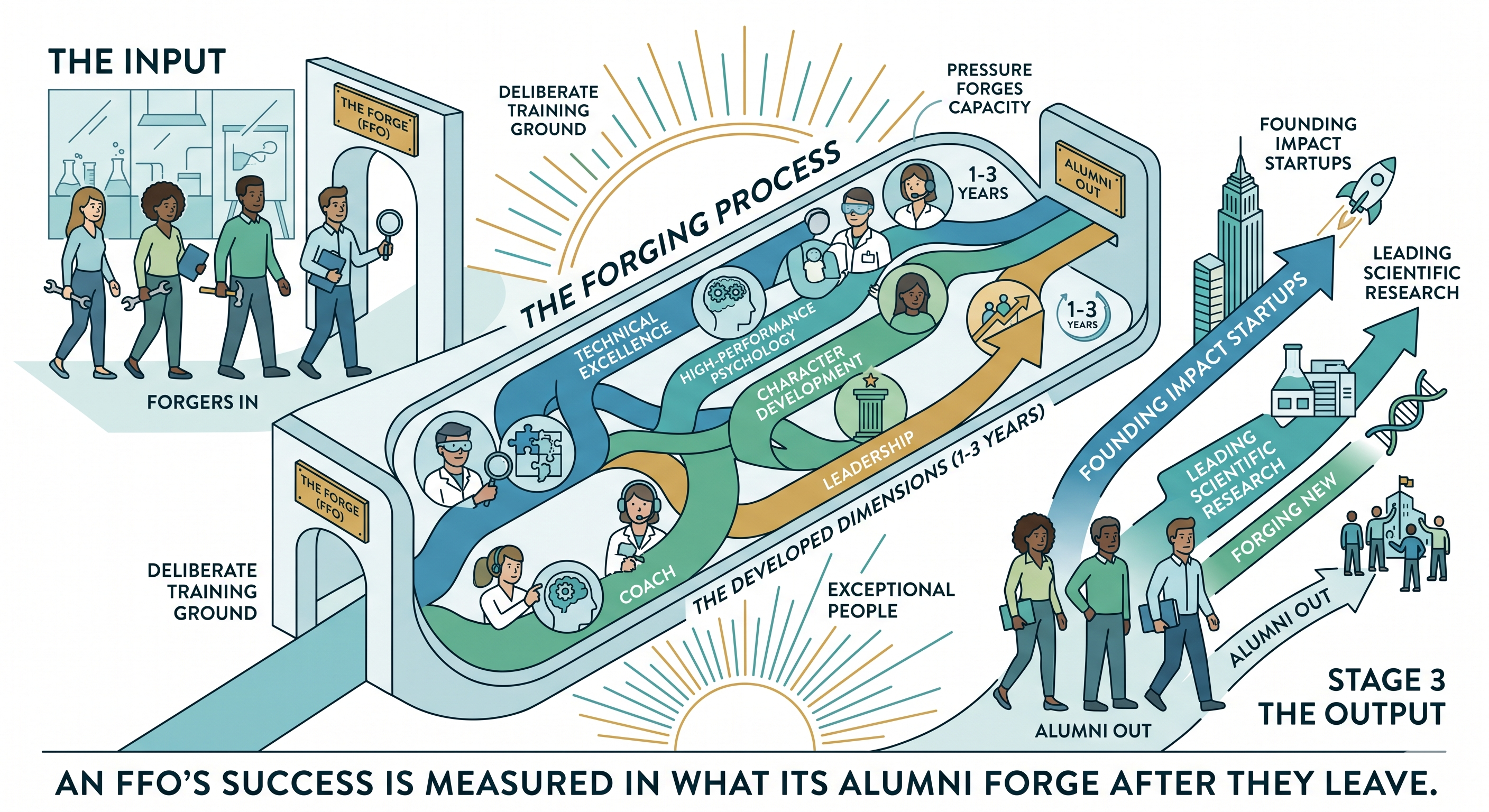
Inspired by the concept of Focused Research Organizations (FROs), I call this new kind of endeavor a Focused Forging Organization (FFO): an organization that takes on a hard real-world problem and uses it as a training ground for producing exceptional people.
An FFO's main impact won't be what it creates while it exists, it'll be what its people go on to build, lead, and forge in turn after they leave.
This essay is a sketch of the idea. There's plenty I haven't yet figured out, and my hope is it's a useful starting point for interesting conversations.
So, what's an FFO?
An FFO, or Forge, is essentially a small, high-paced organization that exists as a training ground for a set of selected fellows (let's call them Forgers) to develop their character, high-performance, and leadership skills alongside the technical ones they already possess.
The assumption underlying this design is that exceptional people are made by practicing those skills in real situations, with real stakes and tight feedback loops. So rather than pulling people out of their work environment to upskill them in classrooms and weekend retreats, a Forge makes that training the focus of the organization itself. Just as elite military and sports teams embed high-performance psychologists in training sessions and games, so does a Forge.
That means an FFO has to be a real organization working on a real problem, and the problem has to be hard, hard enough to put Forgers under genuine pressure. That pressure is what accelerates their development.
It also means the experience must be time-boxed: Forgers stay for a defined period. I suspect a duration of 1-3 years might work well. Long enough to properly develop the skills, and short enough that complacency doesn't have time to set in.
A Forge also contains a small permanent staff team: coaches, mentors, and operators whose role is to hold the standards, run the deliberate-development aspects of the Forge, provide the tight feedback loops, and keep the institution coherent as Forgers join and leave.
Eventually, a Forge's success will be measured in what its alumni Forgers go on to build, lead, and forge in turn after they leave.
What can you expect as a Forger?
FFOs are designed to develop Forgers across three dimensions. This three-way integration is what differentiates them from other places. Most institutions train one or two of these well, but rarely all three together.
The first dimension is technical. Just like any other fast-paced small organization, an FFO requires Forgers to deliver high-quality work. This is no different from, say, a high-performing startup. The presence of these high expectations is important, as it creates the background pressure under which the other skills (those that are usually overlooked) can be developed.
The second is high-performance psychology. The goal here is to produce individuals with the ability to focus, recover, and deliver against high standards, under pressure, over years, all the while remaining immune to burnout and having a good time.
Here, elite sports and special military forces are quite far ahead and we can learn a lot from those environments. Examples include Pete Carroll and Michael Gervais with the Seattle Seahawks, George Mumford with the Bulls and Lakers, and Eric Potterat with the US Navy SEALs.
The third dimension is character. It's a word that's fallen a bit out of fashion and is thrown around with various meanings, so it's worth being explicit about what we mean.
Character is the set of durable dispositions a person carries with them (such as integrity, humility, drive, courage, accountability, temperance) that show up most clearly under pressure and when no one is watching. It's what Aristotle used to call Practical Wisdom.
There's a growing modern research base treating character as observable and developable rather than fixed or mystical. The work of Mary Crossan and her colleagues at the Ivey Business School is a good starting point, and so is the Oxford Character Project and up-and-coming organizations such as Virtuosity.
A Forge makes the deliberate cultivation of character one of its explicit design goals, rather than considering it, as most organizations do, as fixed and up to luck and personality.
But isn't that the same as...
Sometimes, when you're not sure how to define a thing, it's helpful to define what the thing is not. At first, you may be thinking an FFO is basically a variant of some other existing type of institution.
I think it's different. A Forge is not:
-
a Focused Research Organization: an FRO produces research, an FFO produces people.
-
a founder fellowship: fellowships fund individuals to work on their own ideas, while an FFO is structured to elevate a group of high-potential individuals by working on a single shared problem.
-
a normal startup or company: a startup builds a product through its people, while an FFO builds its people through a product.
-
a bootcamp or training program: those happen off-the-job, while an FFO happens in the work itself.
A few other thoughts...
-
We shouldn't expect Forgers to become amazing at everything. A Forge should be an environment where people get extremely good at what they're naturally good at, and address the weaknesses that limit their impact and are otherwise ignored by other institutions.
-
One hypothesis I keep coming back to: this kind of organization, despite being designed for training, might actually be more competitive than other existing organizations or competitors. If true, the conclusion might be that an FFO is actually sometimes just a better way to run a company.
-
We could imagine a model where Forgers rotate through different roles inside the organization. For example, running operations for a quarter, leading a workstream, or sitting in the CEO seat for a defined period. I don't know how well this would work in practice, but I'd like to explore the idea more.
-
We could also imagine a Forge drawing on environments built to develop specific skills at extreme intensity, through deliberate rotations: learning how to master listening to others from crisis-hotline volunteers, how to remain calm under pressure from astronaut-like professionals, how to make decisions under uncertainty from emergency physicians, or how to negotiate from hostage-rescue teams. I don't know yet how this would slot into the rest of the design, but I suspect the fastest way to develop certain skills is to put Forgers in environments that put pressure on those skills in ways that normal office work does not.
-
One more thing on character. By design, the people who pass through a Forge are likely to end up successful, and with that comes power, money, and influence. We've all seen what happens when those land on people without the character to hold them. So character formation isn't only about making Forgers more effective at the work, it's also about making sure the people we're deliberately accelerating toward positions of power are, well, good humans.
Why do we need this in the first place?
This is me somewhat rambling, you might want to skip this section.
The binding constraint on solving hard technological or scientific problems that take years of dedicated effort and hard work is sometimes capital, sometimes ideas, but more often than not, it's people. Exceptional people. People who can do world-class ground-breaking work, sustain it across years of failure and pressure, and bring others up alongside them.
Those people exist, and you might have come across some of them. As we seek to tackle the big challenges of our time, we will need more of them to lead. FFOs aim to quickly bring those people to even higher levels.
The issue is: our institutions are not really designed to produce those people on purpose. If anything, they often emerge by accident, as a byproduct of something else, or despite our existing systems and institutions.
Schools and universities are remarkable early training grounds. For most of us, they provided the foundations we still rely on. But their goal is to teach knowledge and skills at scale. They don't specialize in developing the rest of what makes someone exceptional.
Startup accelerators, incubators, and similar programs try to develop talent more directly. They've been an effective launchpad for many ambitious founders, providing capital, networks, and tactical guidance at a critical moment. But their main goal remains building profitable companies, and the people-development work often sits at the edges of those programs. The growth that makes a founder exceptional still tends to happen on their own time.
Startups and fast-paced organizations can also provide an amazing training ground. The pace and expectations present in those environments can be a great catalyst for fast personal growth. Examples include DeepMind and OpenAI in the AI world, Pixar in animation, and The Daily Show under Jon Stewart in comedy. These organizations are famous because of what they produced, but more importantly because of who they produced. FFOs aim to replicate and extend this pattern.
The programs that do try to develop individuals on purpose (leadership programs, MBAs, executive coaching, high-performance training) often draw on real research and practice. They've helped many people develop frameworks for thinking through hard decisions and sharpen self-awareness about their own inner world. But almost all of their teaching happens in fabricated environments and away from the situations in which we want them to perform, whether in classrooms and weekend retreats or in special projects and coaching sessions.
The ambition behind FFOs is to close this gap.
What comes next?
More thinking, I guess?
As I suspect you may have figured out by now, this idea is still in its early days. I have a strong intuition there's a real thing here, but I'm still struggling to articulate that thing very well.
At this point, I'm looking to find people who share this intuition. If this is you, please do reach out! I hope to continue developing this idea, ideally with others.
One day in the not-too-distant future, I might consider starting some kind of organization. I would love it to be some variant of a Forge.
I think we owe it to the world to create environments that purposefully forge the leaders we want at the top of the mountain. FFOs may be one way to get there.
~ Robin
A special thanks to the many people that helped shape this idea through various conversations over the years. Specifically: Corey and Mary Crossan for introducing me to character research, Marcus Lefton and FRC for awesome high-performance insights, and Callum and the whole Centuriae writing gang.